

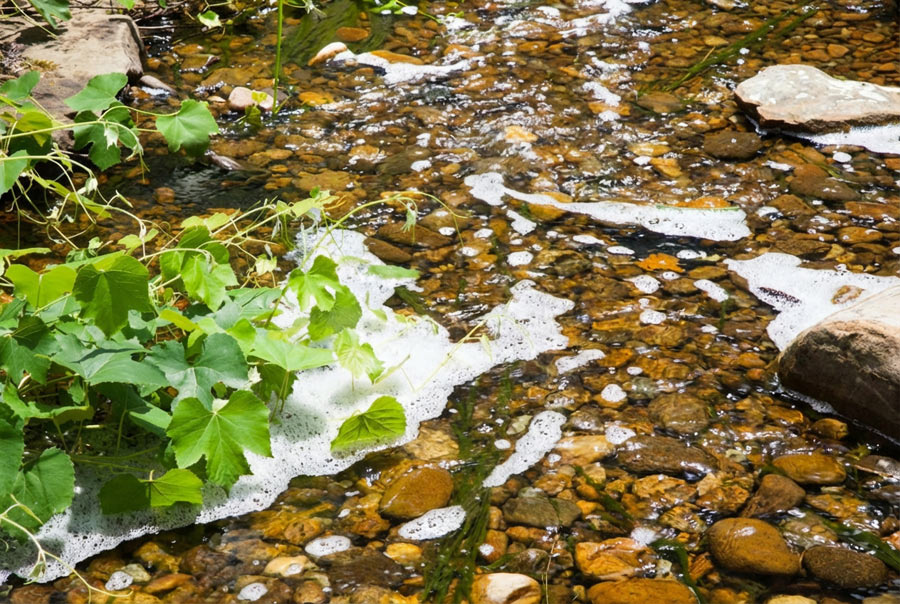
If you spend enough time around streams, roadside ditches, or lakes, you will eventually notice patches of foam collecting along the edges or drifting in slow-moving water. For many people, the immediate assumption is that the foam must be pollution. In reality, most of the foam seen in natural waterbodies is completely harmless and is simply the result of organic materials breaking down. At the same time, there are situations where foam can indicate a problem, and understanding the difference is important for anyone involved in stormwater management or environmental protection.
Natural foam forms when organic matter, such as leaves, algae, and other plant material, decomposes in the water. As these materials break down, they release compounds known as surfactants. These are naturally occurring substances that reduce the surface tension of water, allowing air to mix in and form bubbles. When water is agitated, such as during rainfall, flowing over rocks, or moving through culverts, these bubbles accumulate and create foam.
This type of foam is often tan, light brown, or off-white in color, and it tends to gather in eddies, along shorelines, or in slower sections of a channel. It may appear in streaks or patches and can persist for some time, especially when conditions continue to supply both organic material and agitation. In heavily wooded or wetland areas, this kind of foam is particularly common and should generally be considered a normal part of the ecosystem.
Despite its sometimes unappealing appearance, natural foam is not harmful. In fact, it is an indicator that organic processes are actively occurring within the waterbody. These processes are part of nutrient cycling and ecosystem function. The presence of natural foam alone is not a reason for concern, and in many cases, it is simply a sign of a healthy system rich in organic input.
However, not all foam is benign. Certain types of foam can be the result of illicit discharges or pollutant inputs, particularly those containing synthetic surfactants. These may originate from sources such as detergents, wash water, industrial discharges, or sanitary sewer overflows. Unlike natural foam, which forms gradually and is tied to environmental conditions, polluted foam often appears suddenly and may be localized near an outfall or discharge point.
There are several characteristics that can help distinguish potentially problematic foam from natural foam. Color is one factor. While natural foam is typically earthy in tone, polluted foam is often bright white and may appear more uniform or “sudsy,” resembling soap bubbles. Odor is another key indicator. Natural foam generally has an earthy or musty smell, consistent with decomposing vegetation. In contrast, foam associated with illicit discharge may have a noticeable fragrance, soapy scent, or even a chemical odor.
Behavior and persistence can also provide clues. Natural foam tends to break apart easily and may dissipate as conditions change. Foam from synthetic sources can be more stable, holding its structure longer and sometimes forming thicker accumulations. Additionally, if foam is consistently observed at the same location, particularly during dry weather when there is little natural runoff, it may warrant further investigation.
Context is critical. Foam observed downstream of a dense forest after a rainstorm is likely natural. Foam discharging directly from a pipe during dry weather, especially with a strong odor, is far more suspicious. Field staff and inspectors should consider surrounding land use, recent weather conditions, and proximity to potential sources when evaluating what they are seeing.
From a stormwater management perspective, this distinction matters. Misidentifying natural foam as pollution can lead to unnecessary concern and wasted resources. Conversely, dismissing polluted foam as natural can allow illicit discharges to continue unchecked, potentially degrading water quality and harming aquatic life.
Training and awareness are key. Crews working in the field should be familiar with the visual and sensory differences between natural and synthetic foam. Simple observations, such as color, smell, location, and timing, can often provide enough information to determine whether further investigation is needed. In cases where uncertainty remains, water quality sampling can confirm the presence of detergents or other contaminants.
Ultimately, foam on the water is not inherently good or bad. It is a visible indicator of processes occurring within the system. Most of the time, it reflects natural biological activity and poses no threat. Occasionally, it serves as a warning sign of something that does not belong. Knowing the difference allows municipalities and environmental professionals to respond appropriately, protecting both their infrastructure and the ecosystems they are responsible for managing.