

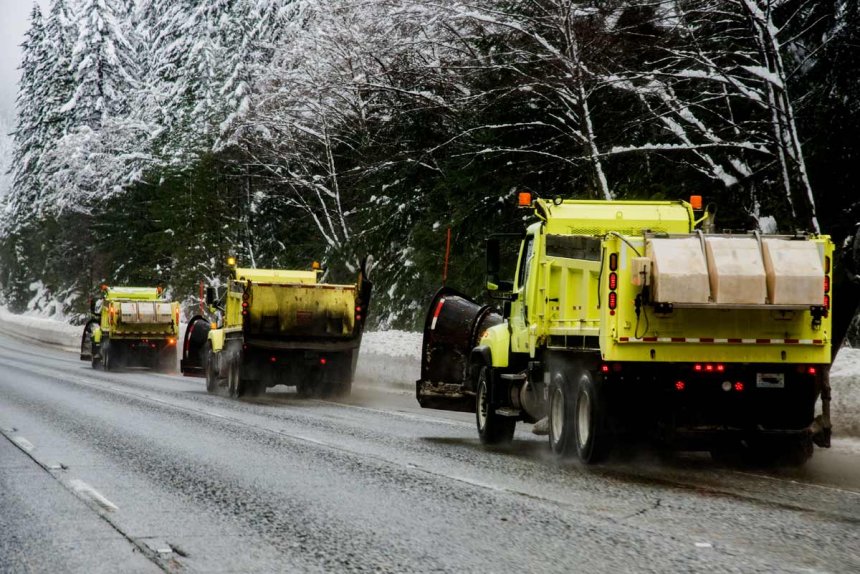
Winter maintenance crews face a difficult balancing act. Roads must remain safe and passable during snow and ice events, but the materials used to achieve that safety can have significant and long-lasting impacts on local waterways, groundwater supplies, soils, vegetation, and stormwater infrastructure.
For decades, sodium chloride, commonly known as road salt, has been the primary tool used to combat icy pavement conditions. It is inexpensive, effective, easy to store, and readily available. Unfortunately, once road salt enters the environment it does not break down or disappear. Instead, it moves through stormwater systems and accumulates in streams, rivers, ponds, wetlands, and groundwater aquifers. Today, highway departments, public works agencies, and transportation organizations are increasingly adopting smarter winter maintenance practices that maintain roadway safety while reducing unnecessary salt use and protecting valuable water resources.
When snow and ice melt, dissolved salt is carried away by stormwater runoff. Catch basins, roadside ditches, culverts, storm sewers, and drainage channels efficiently transport that runoff directly to nearby waterbodies, often with little or no opportunity for treatment or removal. Unlike many pollutants, chloride cannot be filtered out by conventional stormwater practices once it has dissolved in water. It passes through detention basins, vegetated swales, and sediment control structures largely unaffected. As a result, chloride concentrations can steadily increase in receiving waters over time. Elevated chloride levels can harm fish, amphibians, aquatic insects, and other freshwater organisms. Salt contamination can also alter aquatic ecosystems, damage roadside vegetation, degrade soils, and impair drinking water supplies drawn from groundwater sources. Road salt also accelerates corrosion of bridges, culverts, guide rails, vehicles, reinforcing steel, and concrete infrastructure, increasing maintenance costs and shortening asset service life.
One of the most effective salt reduction strategies is preventing snow and ice from bonding to pavement in the first place. Applying salt brine before a storm, commonly referred to as anti-icing, creates a barrier between the pavement surface and incoming precipitation. Because snow and ice cannot bond as strongly to the road surface, plowing operations become more effective and substantially less salt is needed afterward. Pre-treatment applications often reduce overall salt usage by 50 to 75 percent compared to traditional reactive salting methods.
Many agencies unknowingly apply more material than necessary because spreaders are improperly calibrated or application rates have not been updated to reflect current practices. Routine calibration ensures that the desired amount of material is delivered at a given vehicle speed and spread width. Even modest reductions in application rates can produce substantial financial savings while reducing chloride loading to local waterways.
Air temperature and pavement temperature can differ significantly during winter weather events. Decisions based solely on air temperature often result in unnecessary or ineffective salt applications. Infrared pavement thermometers and road weather information systems allow operators to determine when salt will be effective and when other approaches may be more appropriate.
Modern forecasting tools provide detailed information about precipitation type, intensity, timing, pavement temperatures, and freezing conditions. Access to accurate weather intelligence allows highway departments to better time anti-icing operations, avoid unnecessary applications, and deploy resources more efficiently.
Winter maintenance operators make thousands of decisions during a snow season. Training crews on application rates, pavement temperature interpretation, storm response strategies, and equipment operation often produces immediate reductions in salt use without compromising public safety. Many states now offer formal winter maintenance certification programs focused specifically on salt management best practices.
Some agencies supplement traditional salt with agricultural by-products such as beet juice derivatives, molasses-based additives, cheese brine, or other organic materials. These additives can improve adherence to pavement surfaces, reduce bounce and scatter during application, and allow materials to remain effective at lower temperatures. While not a complete replacement for salt, they can help reduce overall chloride usage when properly implemented.
Reducing overlap between plow routes lowers fuel consumption, labor costs, and material usage. Many municipalities now use GPS tracking, route management software, and geographic information systems to improve efficiency and ensure that treatment efforts are focused where they are most needed.
Municipal roads are only one source of winter chloride pollution. Parking lots, sidewalks, private roads, and driveways often receive far more salt per square foot than public highways. Property owners can help reduce chloride pollution by applying salt sparingly, sweeping up excess material after storms, and using traction materials such as sand or stone screenings where appropriate. It is also important to recognize that a wet pavement surface is not necessarily an unsafe pavement surface. Bare and wet roads are often the intended outcome of modern winter maintenance practices and do not automatically indicate inadequate treatment.
Winter road maintenance will always remain an essential public service, particularly in northern climates where snow and ice are a seasonal reality. The goal is not to eliminate salt use entirely, but rather to use the right amount, at the right place, at the right time. Every pound of salt that stays out of a storm drain is a pound that does not enter a stream, pond, wetland, or aquifer. Through improved technology, better training, smarter operations, and a greater understanding of stormwater impacts, communities can continue to provide safe winter travel while protecting the water resources that sustain both people and ecosystems. Safer roads and cleaner water are not competing priorities. With thoughtful winter maintenance practices, they can be achieved together.