

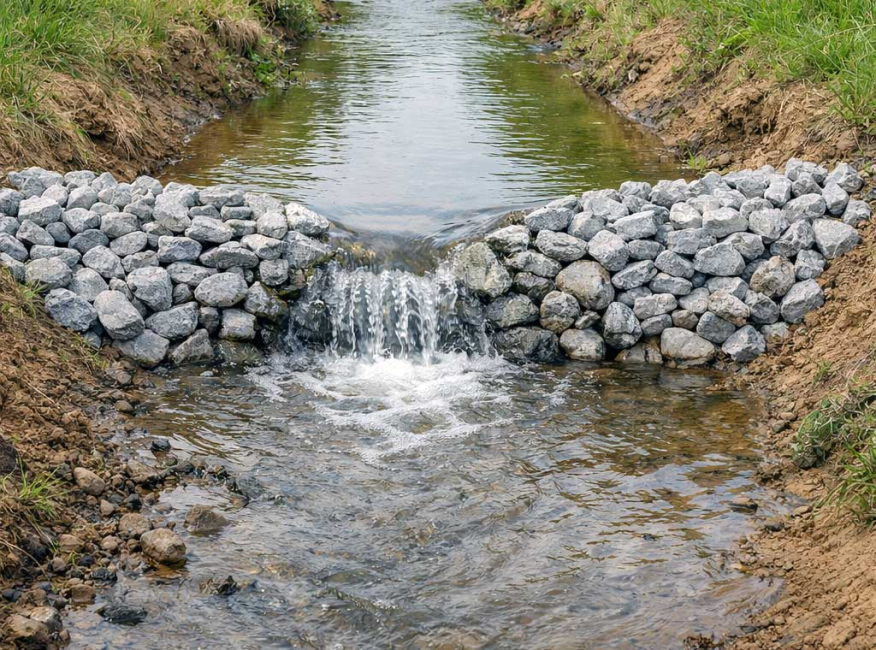
A check dam is a small, low barrier constructed across a channel, swale, or drainage ditch to slow the velocity of flowing stormwater, reduce erosion, and promote sediment deposition. It is typically installed perpendicular to the direction of flow and is used in both temporary and permanent stormwater management applications.
The primary function of a check dam is to dissipate energy by interrupting and slowing the flow of water. As runoff encounters the check dam, water temporarily ponds upstream of the structure, reducing velocity and allowing suspended sediments to settle out. The flow then passes over or through the dam at a reduced speed, minimizing downstream erosion and channel degradation.
Check dams are commonly used in construction site erosion and sediment control, where temporary installations made of stone, gravel, logs, or sandbags are placed in ditches or swales to prevent sediment-laden runoff from leaving the site. In permanent stormwater systems, check dams may be incorporated into bioswales or naturalized channels to enhance infiltration, improve water quality, and create a stepped flow profile.
A key design feature of check dams is that they are typically installed in a series, rather than as a single structure. Proper spacing ensures that the crest elevation of each downstream dam is at or near the toe of the upstream dam, creating a stepped or terraced effect. This configuration maximizes energy dissipation and prevents concentrated flow from re-accelerating between structures.
Check dams are usually constructed from durable materials such as riprap (stone), but may also be made from logs, earth, or manufactured products depending on the application and expected lifespan. The center of the dam is often slightly lower than the edges to direct overflow toward the middle of the channel and prevent bypass along the banks.
While check dams are effective at reducing velocity and capturing coarse sediments, they are not designed to provide complete sediment removal or long-term storage. Accumulated sediment must be periodically removed to maintain effectiveness, particularly in temporary applications.
A check dam is a small transverse barrier used to slow stormwater flow, reduce erosion, and promote sediment settling within channels or swales. It is a simple yet highly effective tool for both temporary erosion control and permanent stormwater management when properly designed, spaced, and maintained.