

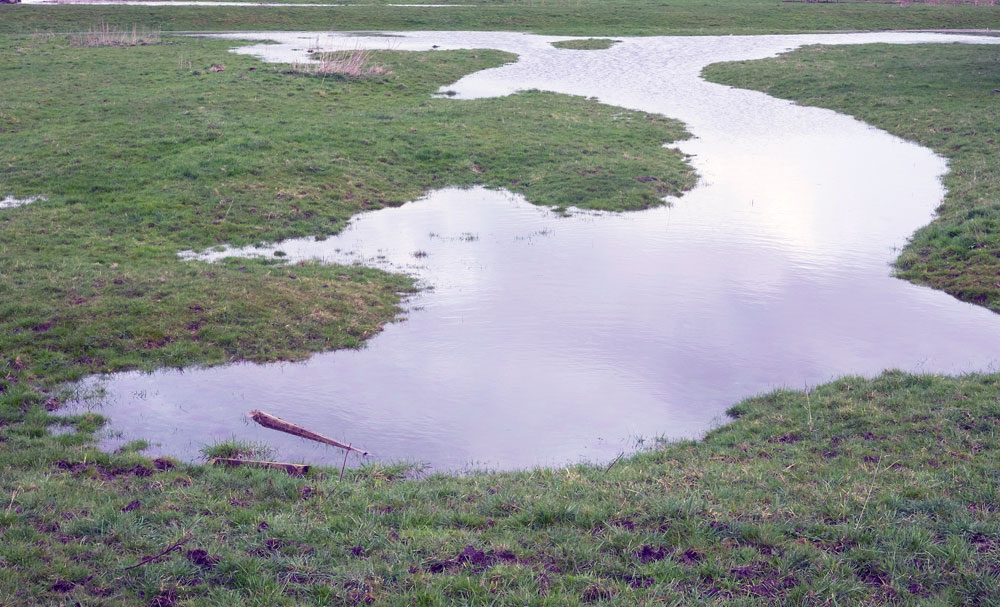
Infiltration-excess runoff is a type of surface runoff that occurs when the rate of precipitation exceeds the soil’s infiltration capacity, causing excess water to accumulate on the ground surface and flow downslope as overland flow. It is one of the primary mechanisms by which runoff is generated in both natural and developed environments.
This process begins when rainfall intensity surpasses the maximum rate at which soil can absorb water. Even if the soil is not fully saturated, water cannot infiltrate quickly enough, resulting in ponding at the surface. Once this surface storage is exceeded, the excess water begins to move laterally as runoff.
Infiltration-excess runoff is most commonly associated with intense, short-duration storm events, where rainfall rates are high relative to the soil’s ability to absorb water. It is also prevalent in areas with low-permeability soils, such as clays, or where soils have been compacted or disturbed by development. Impervious surfaces such as pavement and rooftops effectively have zero infiltration capacity, meaning that nearly all precipitation becomes runoff immediately.
This type of runoff is often referred to as Hortonian flow, named after Robert E. Horton, who first described the process in detail. It contrasts with saturation-excess runoff, where runoff occurs because the soil is already fully saturated rather than because rainfall intensity exceeds infiltration capacity.
In stormwater management, infiltration-excess runoff is a critical concept for understanding how urbanization affects hydrology. The increase in impervious surfaces and soil compaction significantly reduces infiltration capacity, leading to greater runoff volumes, higher peak flows, and more rapid drainage. This, in turn, contributes to flooding, stream erosion, and the transport of pollutants.
Managing infiltration-excess runoff typically involves strategies that increase infiltration capacity or reduce effective rainfall intensity at the surface, such as permeable pavements, soil restoration, vegetated systems, and other green infrastructure practices.
Infiltration-excess runoff describes a fundamental hydrologic process in which rainfall overwhelms the soil’s ability to absorb water, resulting in the generation of surface runoff.