

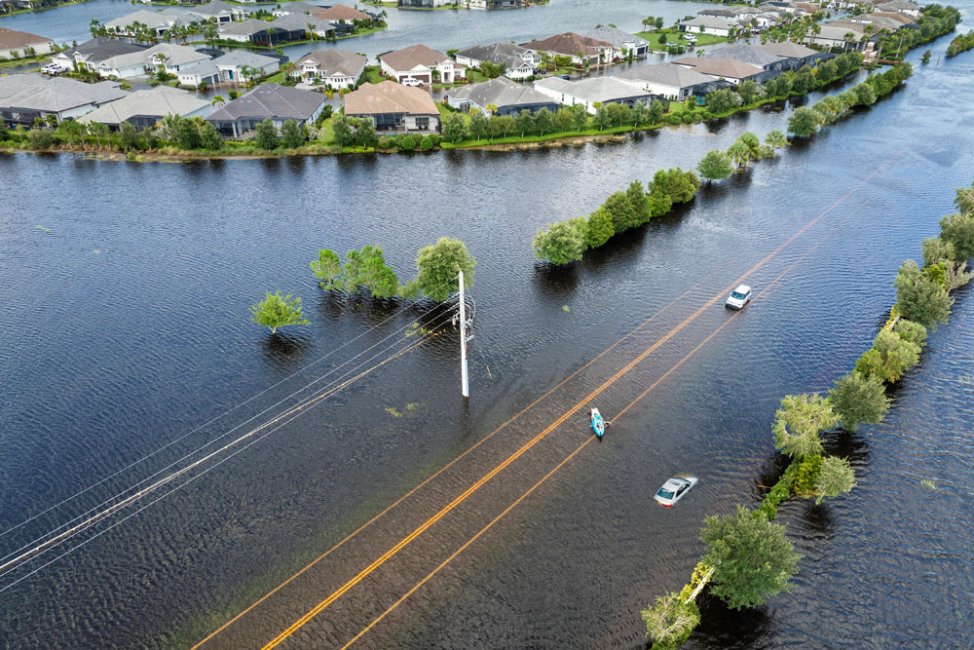
Flooding is the condition in which water overflows or accumulates onto land that is normally dry, resulting from the inability of a natural or engineered drainage system to convey, store, or infiltrate water at the rate it is being generated. In stormwater management, flooding occurs when runoff volumes or flow rates exceed the conveyance capacity or storage capacity of the system, causing water to spread beyond its intended boundaries.
Flooding can arise from a variety of hydrologic and hydraulic conditions. It is most commonly associated with intense or prolonged precipitation events, rapid snowmelt, or a combination of both, which generate large volumes of runoff in a short period of time. In developed areas, impervious surfaces such as roads, rooftops, and parking lots significantly reduce infiltration and increase runoff rates, making flooding more likely and more severe. Additionally, undersized infrastructure, blockages from sediment or debris, high downstream water levels, or system failures can all contribute to flooding.
In the context of stormwater systems, flooding may occur in several forms. Localized or urban flooding happens when storm drains, pipes, or inlets are overwhelmed, leading to ponding on streets or properties. Channel or stream flooding occurs when flow exceeds the banks of a watercourse, spreading into adjacent floodplains. Overland flooding can also occur when runoff cannot enter the drainage system efficiently and instead flows across the ground surface.
Flooding has both physical and environmental impacts. It can damage infrastructure such as roads, bridges, and buildings, disrupt transportation and public services, and pose risks to human safety. From an environmental standpoint, flooding can cause erosion, transport pollutants into receiving waters, and alter stream channels and benthic habitats. While flooding is often viewed as a hazard, it is also a natural process in many ecosystems, particularly in floodplains, where periodic inundation supports nutrient exchange and habitat diversity.
Effective stormwater management seeks to reduce the frequency, magnitude, and impacts of flooding through a combination of strategies, including increasing conveyance capacity, providing detention and retention storage, promoting infiltration, and preserving natural floodplain functions. In summary, flooding represents the point at which water exceeds the limits of the drainage system and spreads into areas not intended to convey or store it, with significant implications for both human and environmental systems.