

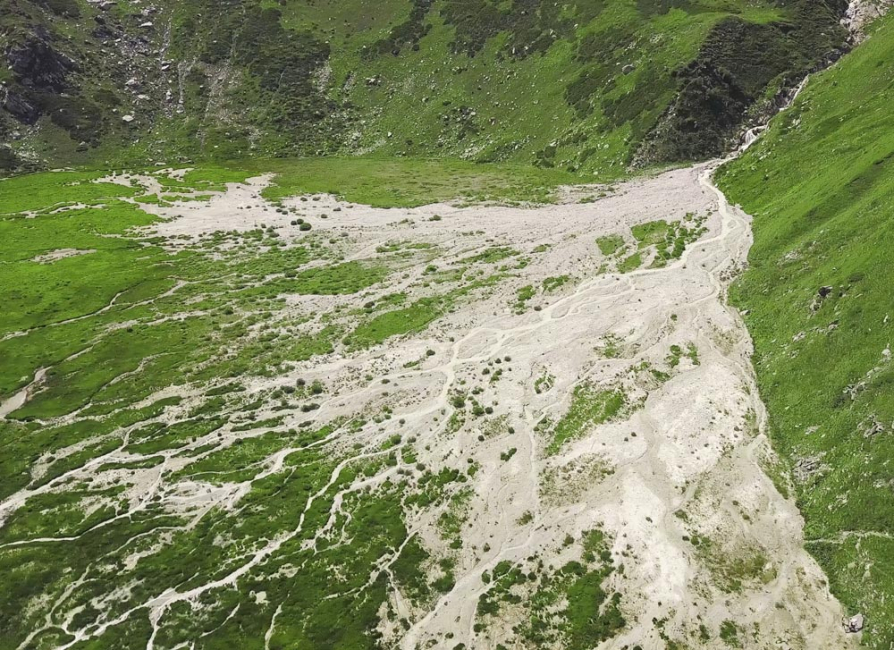
Overland flow is the movement of water across the land surface as sheet flow or shallow, unconfined flow before it becomes concentrated into defined channels such as rills, swales, or streams. In hydrology and stormwater management, overland flow represents the initial phase of surface runoff as water travels downslope toward a drainage system or receiving water.
Overland flow occurs when precipitation or snowmelt exceeds the soil’s ability to absorb water, either because rainfall intensity surpasses infiltration capacity or because the soil is already saturated. These conditions correspond to processes such as infiltration-excess runoff and saturation-excess runoff. Once water begins to move across the surface, it forms a thin, continuous layer that is influenced by slope, surface roughness, land cover, and depressional storage.
As overland flow travels, it can detach and transport soil particles, contributing to erosion processes such as sheet erosion. If the flow becomes more concentrated, it may evolve into rill or gully erosion, increasing its erosive potential and sediment transport capacity.
The velocity and depth of overland flow are generally low compared to channelized flow, but they are critical in determining how quickly runoff reaches stormwater systems and how much infiltration occurs along the flow path. Vegetation, surface roughness, and soil permeability all act to slow overland flow, promote infiltration, and reduce runoff volume.
In stormwater management, controlling overland flow is important for reducing peak discharge, minimizing erosion, and improving water quality. Practices such as vegetative cover, contour grading, level spreaders, and infiltration systems are used to interrupt, disperse, and slow overland flow, encouraging infiltration and reducing its ability to transport sediment and pollutants.
Overland flow is a fundamental component of the runoff process, linking precipitation to channelized flow and playing a key role in both hydrologic response and erosion dynamics within a watershed.