

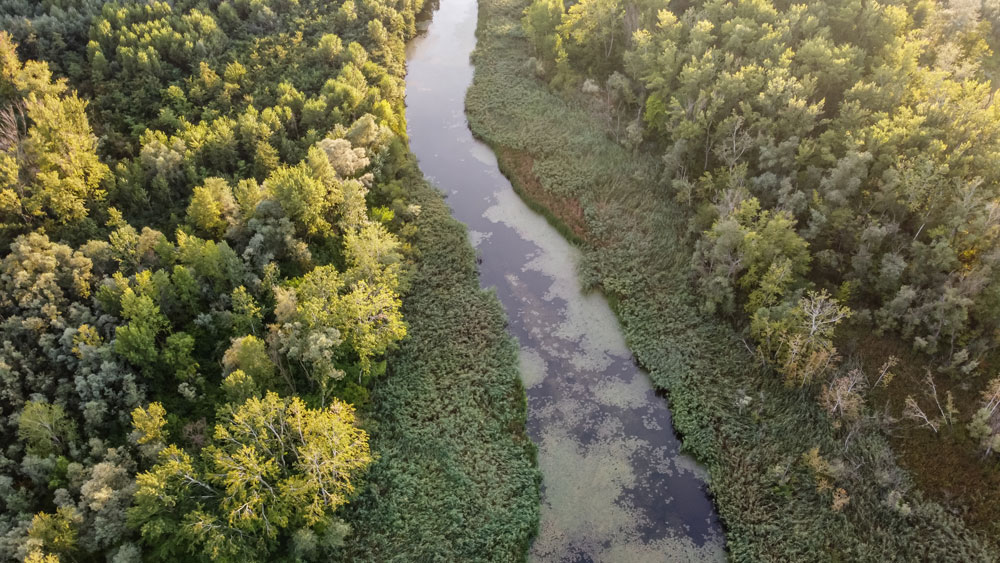
A watershed, also known as a drainage basin or catchment area, is the land area that drains all precipitation and surface runoff to a common outlet, such as a stream, river, lake, or other receiving water body. It is defined by natural topographic boundaries, often referred to as drainage divides, which separate one watershed from another. These divides are typically ridgelines or high points in the landscape that determine the direction of water flow.
Within a watershed, all hydrologic processes are interconnected. Precipitation that falls anywhere in the watershed will eventually move, by way of overland flow, shallow subsurface flow, or groundwater pathways, toward the same outlet point. This makes the watershed a fundamental unit for understanding and managing water resources, as activities in one part of the watershed can directly affect conditions elsewhere.
Watersheds exist at multiple scales, ranging from very small areas that drain to a single culvert or ditch, to vast river basins encompassing thousands of square miles. Larger watersheds are often composed of many smaller subwatersheds, each contributing flow to a larger drainage network. This hierarchical structure is important in stormwater management, as local runoff ultimately contributes to downstream conditions.
In stormwater management, the watershed framework is used to evaluate runoff quantity and quality, design drainage infrastructure, and assess cumulative impacts of land use changes. Development within a watershed, particularly the increase in impervious surfaces, can significantly alter the hydrologic response by increasing runoff volume, accelerating flow rates, and reducing infiltration and groundwater recharge.
Watersheds also play a critical role in water quality protection, as pollutants introduced anywhere within the drainage area can be transported to receiving waters. This makes watershed-based planning essential for controlling nonpoint source pollution, including sediment, nutrients, metals, hydrocarbons, and chlorides.
Effective stormwater management often requires a watershed-based approach, rather than focusing solely on individual sites. This approach considers upstream and downstream interactions, cumulative impacts, and the need to preserve or restore natural hydrologic functions across the entire drainage area.
Overall, a watershed is the fundamental geographic and hydrologic unit that governs how water moves through the landscape, making it central to the planning, design, and management of stormwater systems.