

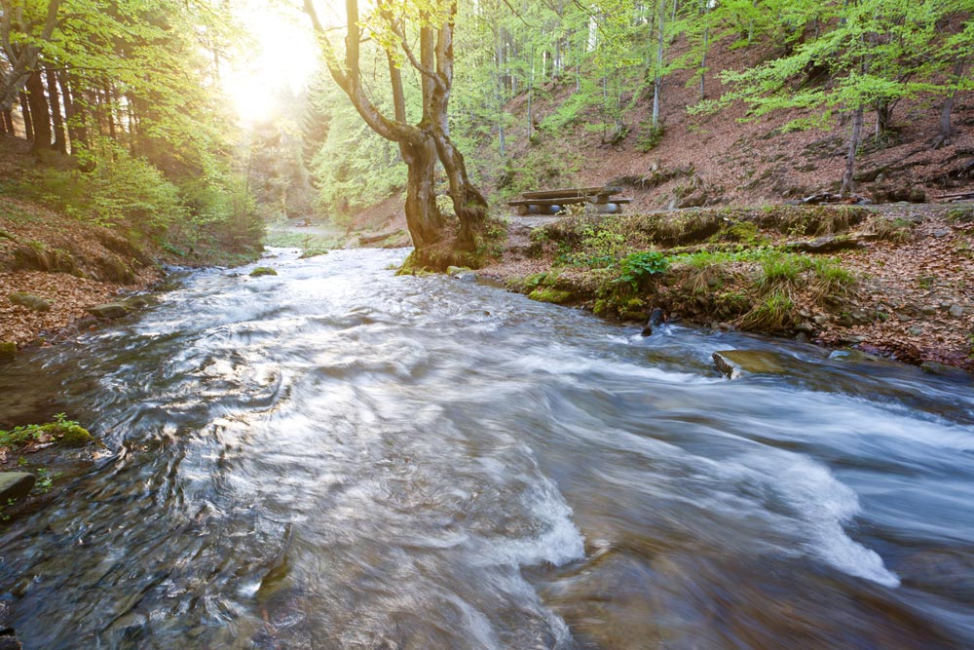
Channelized flow is the movement of water that has become concentrated and confined within a defined pathway, such as a natural stream, ditch, swale, culvert, or other open or closed conveyance system. In stormwater management and hydrology, channelized flow represents the stage of runoff where overland flow has transitioned into a distinct, bounded flow path with measurable depth, width, and velocity.
Channelized flow develops when shallow, unconfined runoff, such as overland flow, begins to concentrate due to topography, surface irregularities, or drainage infrastructure. As water converges into these defined paths, flow depth and velocity increase, resulting in greater hydraulic efficiency and erosive potential.
Unlike diffuse surface flow, channelized flow is governed by the principles of open-channel or pipe flow hydraulics, where factors such as channel slope, roughness, cross-sectional shape, and hydraulic radius influence flow behavior. Because of this confinement, channelized flow can transport larger volumes of water and sediment, and it plays a primary role in conveying stormwater through drainage networks.
Channelized flow is closely associated with erosion processes, particularly channel erosion, as the increased velocity and shear stress within a defined channel can destabilize beds and banks if not properly managed.
In stormwater systems, channelized flow is intentionally utilized in infrastructure such as roadside ditches, storm drains, and culverts to efficiently convey runoff away from developed areas. However, if not properly designed or stabilized, it can lead to excessive erosion, sediment transport, and downstream impacts.
Channelized flow represents a critical phase in the hydrologic response of a watershed, marking the transition from dispersed runoff to organized flow within the drainage system.