

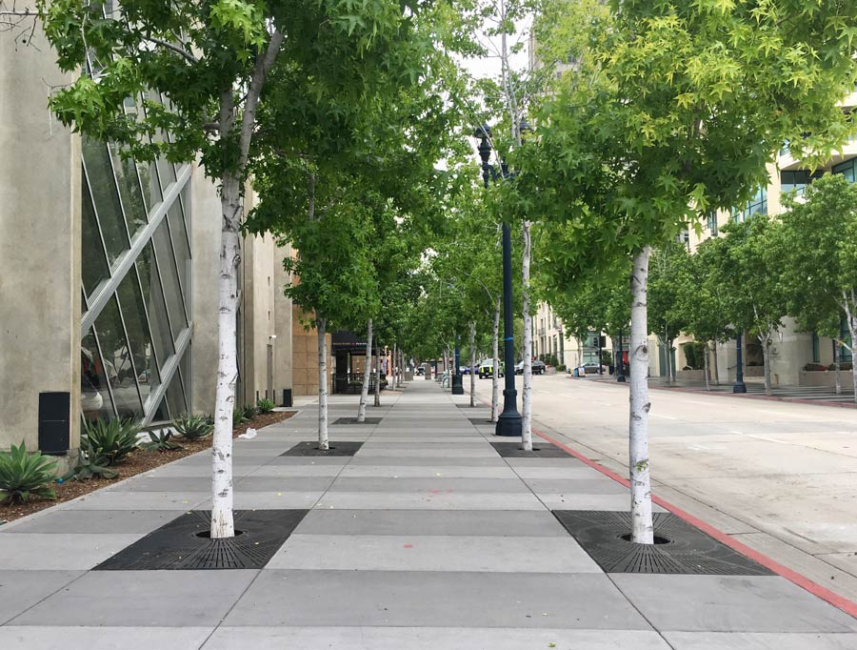
A tree pit is a designated planting area, typically located within sidewalks, streetscapes, parking lots, or other paved urban environments, that provides space for a tree's trunk, roots, and surrounding soil. In traditional urban design, tree pits primarily serve landscaping and urban forestry purposes. In modern stormwater management, however, tree pits are increasingly designed to function as green infrastructure practices that capture, filter, infiltrate, and treat stormwater runoff.
A conventional tree pit usually consists of a small opening in pavement containing soil and a single tree. These installations often provide limited rooting volume and restricted access to water, air, and nutrients, which can result in poor tree health, stunted growth, and reduced lifespan.
Stormwater tree pits, sometimes referred to as stormwater planters or bioretention tree pits, are engineered systems specifically designed to manage runoff from nearby impervious surfaces such as roads, sidewalks, rooftops, and parking lots. Runoff is directed into the tree pit through curb openings, trench drains, sheet flow, or storm sewer connections where it temporarily ponds and infiltrates through engineered soil media.
As stormwater moves through the soil profile, pollutants such as sediment, nutrients, hydrocarbons, metals, and trash are removed through filtration, biological uptake, adsorption, and microbial activity. Water may then infiltrate into the underlying native soils, be absorbed by the tree and surrounding vegetation through evapotranspiration, or discharge through an underdrain system if infiltration is limited.
Tree pits provide several stormwater management benefits, including runoff volume reduction, peak flow attenuation, pollutant removal, groundwater recharge, and thermal mitigation. Trees also intercept rainfall on their leaves and branches, reducing the amount of precipitation that reaches the ground and enters storm drainage systems.
Beyond stormwater treatment, tree pits contribute to improved urban aesthetics, increased property values, enhanced pedestrian environments, reduced urban heat island effects, improved air quality, carbon sequestration, and wildlife habitat creation.
One of the primary limitations of traditional tree pits is their relatively small soil volume. Urban trees often require substantially more rooting space than conventional installations provide, which can lead to root girdling, pavement heaving, drought stress, and premature tree mortality. Modern designs frequently address these issues by incorporating larger soil volumes, suspended pavement systems, structural soils, or connections to adjacent planting areas.
Tree pits are often confused with tree trenches, but the two practices differ significantly. A tree pit generally serves a single tree within an isolated planting area, while a tree trench connects multiple trees through a continuous subsurface soil and storage system that allows for shared rooting volume and greater stormwater treatment capacity.
In stormwater management, tree pits represent an important form of distributed green infrastructure that integrates urban forestry and runoff treatment into highly developed environments where space for larger stormwater practices may not be available.