

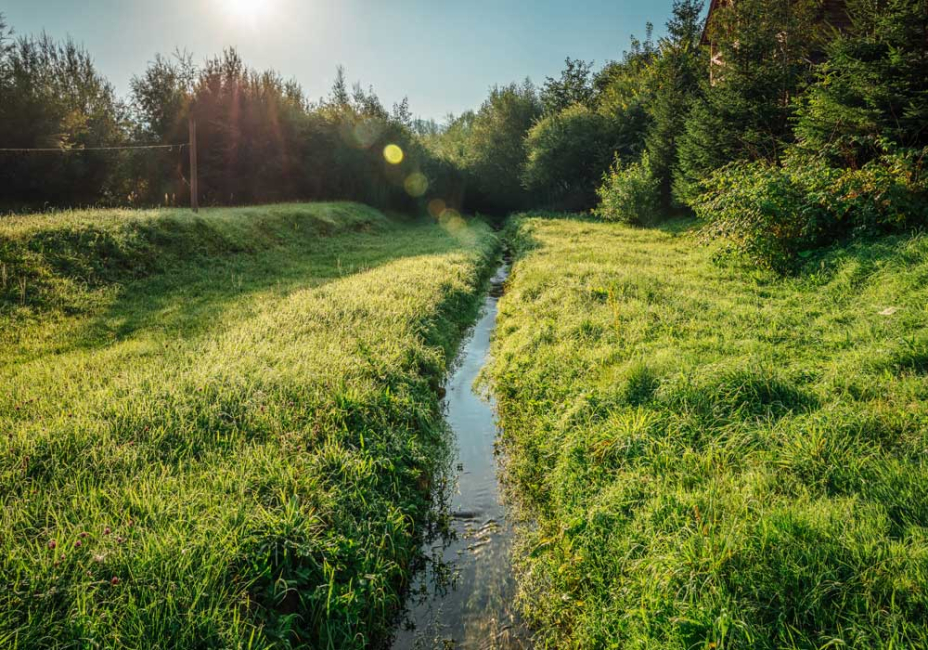
Open channel outfalls occupy a unique space in stormwater infrastructure. They are simple in appearance, often nothing more than a vegetated swale or gently graded channel, yet when properly designed they function as treatment systems, flow control measures, and in northern climates even snow management assets. Unlike a hard pipe discharging directly into a stream, an open channel outfall slows water down, spreads it out, and allows soil and vegetation to do the work that concrete and steel cannot.
At its core, an open channel outfall is about controlled release. Stormwater leaves a closed system such as a pipe or culvert and enters a vegetated, graded channel before reaching its final receiving water. That transition zone matters. Velocity drops. Sediment settles. Pollutants bind to soils. Infiltration begins. Instead of concentrating flow at a single erosion prone point, the system dissipates energy across a broader surface.
There are several configurations that municipalities and designers use, depending on site constraints and performance goals. A basic grass channel is often the most economical option. It looks like a traditional roadside ditch but is intentionally sized to slow runoff and maintain shallow, non erosive flow. The emphasis is not simply moving water, but giving it time to interact with vegetation and soil. When properly graded, these systems can detain and infiltrate smaller storm events while safely conveying larger ones.
Dry swales build on that concept by incorporating engineered soil media and underdrains. In this configuration, runoff filters vertically through a prepared soil bed before being collected by a perforated pipe. This approach is particularly useful along roadways and in residential corridors where water quality treatment is required but space for a full bioretention basin is limited. The underdrain provides reliability, especially in tighter soils, while still allowing meaningful pollutant removal through filtration.
Wet swales function more like linear wetlands. They maintain shallow, standing water or saturated soils for extended periods, allowing wetland vegetation to establish. These systems can enhance nutrient uptake and provide stronger pollutant removal, but they require careful consideration of mosquito management, odor control, and long term maintenance. They are less common in constrained roadside settings but can be effective in larger developments.
Vegetated filter strips are another variation, designed to accept sheet flow rather than concentrated discharge. When runoff can be evenly distributed across a broad, gently sloped vegetated area, sediment and associated pollutants are filtered before reaching a stream or storm conveyance system. The challenge is ensuring that flow remains dispersed. Once runoff becomes channelized, the treatment benefit declines rapidly.
In northern climates, open channel outfalls offer advantages that more structural systems often lack. Because they rely primarily on soil and vegetation, they are less vulnerable to freeze related mechanical failures. However, cold weather introduces design considerations. Frost heave can affect underdrains if drainage is inadequate going into winter. Snow storage introduces high sediment and chloride loads. Culverts associated with open channels can become blocked with ice if undersized or poorly graded.
Good design in these regions focuses on drainage and durability. Underdrains should be large enough to prevent prolonged saturation before freeze up. A substantial gravel base helps protect piping and maintain infiltration capacity. Culverts should be generously sized and installed with adequate slope to reduce ice buildup. Where plowed snow will be stored in swales or filter strips, designers should anticipate heavier spring maintenance, including sediment removal and vegetation repair.
Maintenance is not optional with open channel outfalls. After spring melt, accumulated sand from winter road treatments must be removed to prevent clogging. Salt impacted soils may require rehabilitation to restore structure and infiltration capacity. Vegetation must remain dense and healthy to resist erosion and provide treatment. Without consistent inspection and upkeep, even the best designed system will gradually revert to a simple ditch.
Perhaps the most overlooked benefit of open channel outfalls is their role in peak flow reduction during snowmelt. By providing distributed infiltration along a linear corridor, these systems can reduce the sudden surge of meltwater entering downstream pipes and streams. Even when biological activity is low in winter, the physical processes of infiltration and sedimentation still provide measurable benefit.
For municipalities seeking cost effective stormwater improvements, open channel outfalls represent a pragmatic solution. They can serve as pretreatment upstream of ponds or wetlands, as stand alone water quality measures along roadways, or as transitional features between closed pipe networks and natural receiving waters. They are visible, understandable, and adaptable to a wide range of site conditions.
When thoughtfully designed and properly maintained, an open channel outfall is far more than the end of a pipe. It is a working landscape element that slows water, improves quality, reduces erosion risk, and in cold regions even helps manage snow. In an era where infrastructure budgets are tight and regulatory expectations are rising, that combination of simplicity and performance is hard to ignore.