

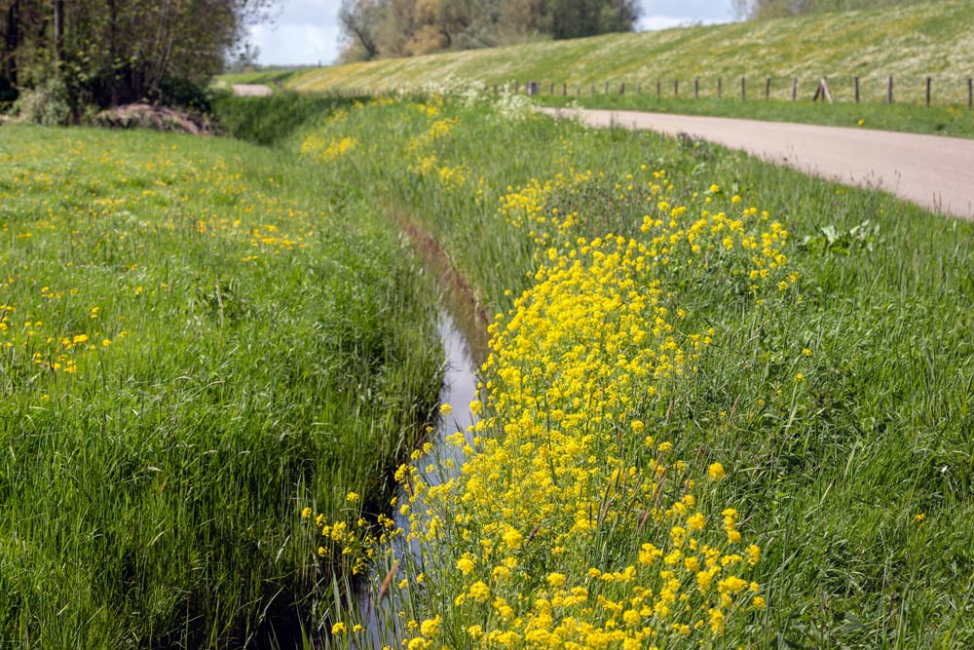
Vegetated swales, also called grassed swales or bioswales depending on design complexity, are shallow, elongated, open-channel drainage features that are lined with vegetation and designed to convey, slow, and treat stormwater runoff. In stormwater management, they function as both conveyance systems and water quality treatment practices, integrating hydraulic performance with natural processes.
A vegetated swale typically consists of a gently sloped channel with a broad, flat or parabolic cross-section, covered with grasses or other dense vegetation. Unlike conventional ditches or storm drains that are designed primarily to move water quickly, swales are intentionally designed to reduce flow velocity. This is achieved through mild longitudinal slopes, rough vegetative cover, and sometimes check dams or engineered soil media that promote temporary storage and infiltration.
From a hydraulic perspective, vegetated swales convey stormwater while attenuating peak flows. By slowing runoff, they reduce erosive forces and downstream flooding potential. The reduced velocity also increases the time water remains in the system, which is critical for treatment processes.
Vegetated swales provide water quality benefits through multiple mechanisms. As runoff flows through the vegetation, filtration removes suspended solids and associated pollutants. Sedimentation occurs as slower velocities allow heavier particles to settle out. Infiltration enables water to move into the underlying soil, where additional treatment occurs through adsorption, microbial activity, and other fate and transformation processes. Vegetation itself contributes through plant uptake of nutrients and by stabilizing the soil, reducing erosion.
There are several variations of vegetated swales. Simple grassed swales are primarily used for conveyance and basic treatment, often along roadways or in residential areas. Enhanced or engineered bioswales may include amended soils, underdrains, check dams, and diverse plantings to improve pollutant removal and infiltration performance. Some designs are intended to fully infiltrate smaller storm events, while others are designed to convey larger flows safely.
In terms of application, vegetated swales are commonly used along highways, parking lots, subdivisions, and other developed areas as an alternative to curb-and-gutter systems. They are a key component of green infrastructure and low impact development strategies, as they help mimic natural drainage patterns and reduce reliance on enclosed storm sewer systems.
Overall, vegetated swales are multifunctional stormwater practices that combine conveyance, storage, infiltration, and treatment. Their effectiveness depends on proper design, including slope, soil conditions, vegetation selection, and maintenance, all of which influence their ability to manage runoff quantity and improve water quality.
Vegetated swales and bioswales are closely related, but they are not always exactly the same, and the difference usually comes down to design intent and level of treatment.
A vegetated swale is a broad term that refers to any shallow, vegetation-lined channel designed to convey stormwater while providing some degree of flow slowing, infiltration, and basic water quality treatment. These are often simple systems, commonly grass-lined, and are frequently used along roadsides or in residential developments as an alternative to curb-and-gutter drainage. Their primary function is conveyance with incidental treatment through processes like sedimentation and filtration.
A bioswale, on the other hand, is a more specific and engineered type of vegetated swale that is intentionally designed to maximize water quality treatment and, in many cases, infiltration. Bioswales typically incorporate enhanced features such as amended soils, dense and diverse vegetation, check dams to slow flow, and sometimes underdrains to manage excess water. They are designed to promote a wider range of fate and transformation processes, including adsorption, microbial activity, and plant uptake, making them more effective at removing dissolved and particulate pollutants.
In practice, the terms are sometimes used interchangeably, especially in informal contexts, which can create confusion. However, in technical stormwater design and regulatory guidance, “bioswale” generally implies a higher-performance system with specific treatment objectives, while “vegetated swale” remains the broader category that includes simpler designs.
So, all bioswales are vegetated swales, but not all vegetated swales meet the design criteria or performance expectations of a bioswale.