

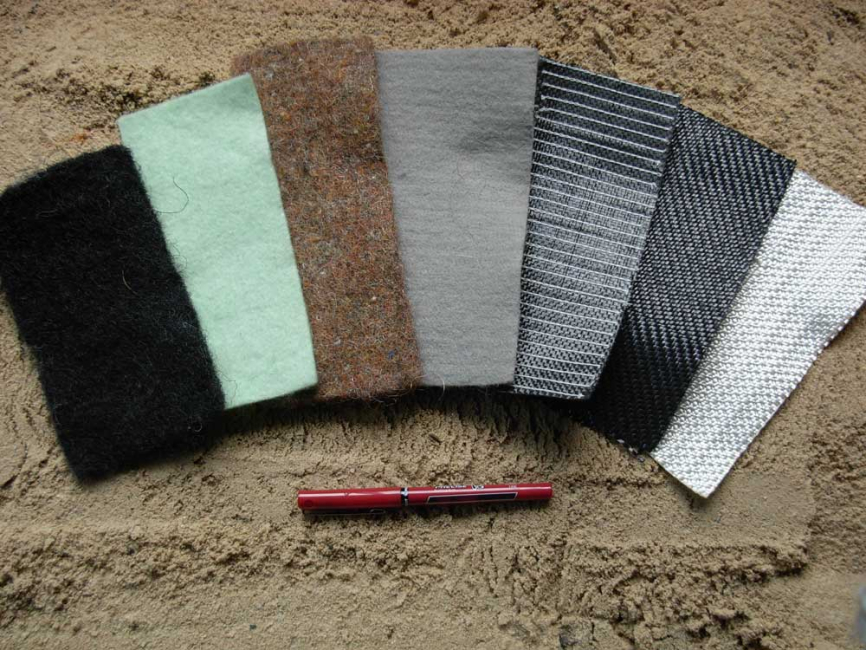
Geotextiles are permeable, synthetic textile materials used in civil engineering and stormwater management to improve soil performance, control erosion, and enhance the stability and longevity of drainage and structural systems. They are typically made from polymers such as polypropylene or polyester and are manufactured in woven, nonwoven, or knitted forms, each with distinct physical and hydraulic properties suited to specific applications.
In stormwater management, geotextiles serve several key functions, often categorized as separation, filtration, drainage, reinforcement, and protection. As separation layers, they prevent the intermixing of different soil types, such as keeping fine subgrade soils from migrating into overlying aggregate layers in roads, swales, or embankments. This helps maintain structural integrity and hydraulic performance over time.
As filtration media, geotextiles allow water to pass through while retaining soil particles. This function is critical in applications such as underdrains, trench drains, and behind retaining structures, where maintaining flow while preventing clogging or soil loss is essential. In erosion and sediment control, geotextiles are often used in silt fences, inlet protection devices, and sediment barriers to intercept sediment-laden runoff and promote settling.
Geotextiles also facilitate drainage by providing pathways for water movement within soil or aggregate systems. Nonwoven geotextiles, in particular, are commonly used to wrap perforated pipes in subsurface drainage systems, allowing water to enter while excluding fines that could clog the system.
In reinforcement applications, woven geotextiles can increase the load-bearing capacity of soils by distributing stresses and improving resistance to deformation. This is especially useful in soft or unstable subgrades. For protection, geotextiles are placed between soils and materials such as geomembranes or riprap to prevent puncture or abrasion.
The effectiveness of geotextiles depends on proper selection based on site conditions, including soil type, hydraulic requirements, expected loads, and environmental factors. When correctly designed and installed, geotextiles are a versatile and durable component of stormwater infrastructure, contributing to improved performance, reduced maintenance, and extended service life of drainage systems.