

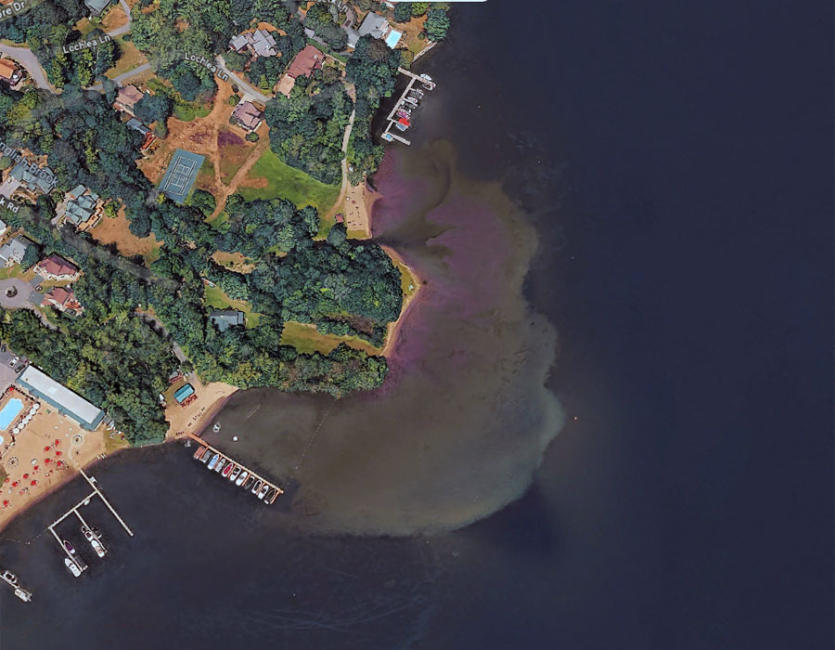
Sediment is a natural part of any water system, but when it accumulates faster than a system can handle, it begins to change the waterbody in ways that are both visible and subtle. Excess sediment alters water clarity, transports nutrients, reshapes habitat, and often creates long-term maintenance challenges. Nowhere is this more evident than at the English Brook delta in Lake George, New York, where decades of stormwater-driven sediment have created a growing and closely monitored example of how land use directly impacts water quality.
The English Brook delta has formed primarily from sand and fine material washed off roadways, particularly from winter deicing operations. As this material is carried downstream during storm events, it settles out when the flow slows upon entering the lake. Over time, this has created a large sediment fan extending into the lake, gradually altering both the physical landscape and the ecological balance of the area.
One of the most immediate and noticeable effects of sediment build-up is reduced water clarity. Lake George is widely known for its exceptionally clear water, and even small increases in suspended or deposited sediment can have an outsized impact. Fine particles remain suspended in the water column, scattering light and reducing visibility. This not only affects the aesthetic value of the lake, which is a major economic driver for the region, but also limits sunlight penetration, which is critical for aquatic plant life and overall ecosystem productivity.
Beyond clarity, sediment acts as a transport mechanism for nutrients, particularly phosphorus. In the case of the English Brook delta, the accumulated material is described as nutrient-rich, meaning it does more than just settle, it actively contributes to ecological change. Phosphorus bound to sediment particles can be released into the water column over time, fueling algal growth. This process can lead to nuisance algal blooms and, in more severe cases, harmful algal blooms that degrade water quality and pose risks to both human and ecological health.
Sediment accumulation also creates ideal conditions for invasive species. The English Brook delta has become a favorable environment for species such as Eurasian watermilfoil, which thrives in nutrient-rich, shallow, and disturbed environments. As sediment builds up, it creates new, shallow habitat zones that would not otherwise exist in a deep, clear lake like Lake George. These newly formed areas allow invasive plants to establish and spread more easily, often outcompeting native species and altering habitat for fish and other aquatic organisms.
Habitat changes extend beyond plant life. Sediment can smother benthic habitats, covering gravel and cobble substrates that are essential for fish spawning and macroinvertebrate communities. As these habitats are buried, biodiversity tends to decline. Species that rely on clean, well-oxygenated substrates are replaced by those that can tolerate finer, more compacted materials. Over time, this shift can ripple through the food web, affecting fish populations and overall ecosystem health.
There are also practical and navigational impacts. The English Brook delta has grown to the point where it interferes with boat navigation, particularly in areas that were once deeper and more accessible. This is a common issue in sediment-impacted waterbodies, where gradual infilling creates hazards that are not always visible from the surface. For a lake that depends heavily on recreation, these changes carry both safety and economic implications.
Recognizing these risks, several organizations have taken an active role in monitoring and managing the situation. The Warren County Soil and Water Conservation District has been closely involved in tracking sediment accumulation and coordinating mitigation efforts. In partnership with groups like the Lake George Association, significant investments have been made to reduce sediment input at its source.
One such effort includes the installation of a stormwater treatment system featuring an Aqua-Swirl separator, designed to capture sediment before it reaches the lake. Complementing this system is a 150-foot sediment basin that intercepts runoff and allows heavier materials to settle out. This basin requires regular maintenance, typically removing 300 to 400 cubic yards of material every one to two years, which highlights the sheer volume of sediment moving through the system. These measures do not eliminate the problem, but they significantly reduce the rate at which the delta grows.
The English Brook delta illustrates an important principle in stormwater management, once sediment enters a waterbody and settles, removal becomes far more difficult and expensive than preventing it in the first place. Dredging and restoration efforts are complex, disruptive, and costly, making upstream controls the most effective long-term strategy.
From a broader perspective, sediment build-up is not just a localized issue, it is a watershed issue. Roads, driveways, construction sites, and disturbed soils all contribute to the sediment load carried by stormwater. In cold climates like upstate New York, winter sand application adds another major source. Without proper controls, these materials inevitably make their way into streams, culverts, and eventually larger waterbodies.
Managing sediment requires a combination of infrastructure, maintenance, and awareness. Practices such as street sweeping, improved ditch and culvert design, stabilization of disturbed soils, and targeted stormwater treatment all play a role. Just as important is ongoing monitoring, which allows organizations to track trends, evaluate the effectiveness of interventions, and adapt strategies over time.
The situation at the English Brook delta serves as both a warning and a model. It shows how quickly sediment can alter a high-quality waterbody, but it also demonstrates the value of proactive management and collaboration. By addressing sediment at its source and maintaining the systems designed to capture it, communities can protect water quality, preserve habitat, and avoid the far greater costs of restoration down the line.
*Note: In my former life as a deputy highway superintentent, I was lucky enough to receive training from Jim Lieberum and Nick Rowell from the Warren County Soil and Water Conservation District, and had called on their expertise on stormwater management many times. They are wonderful, highly-qualified people.