

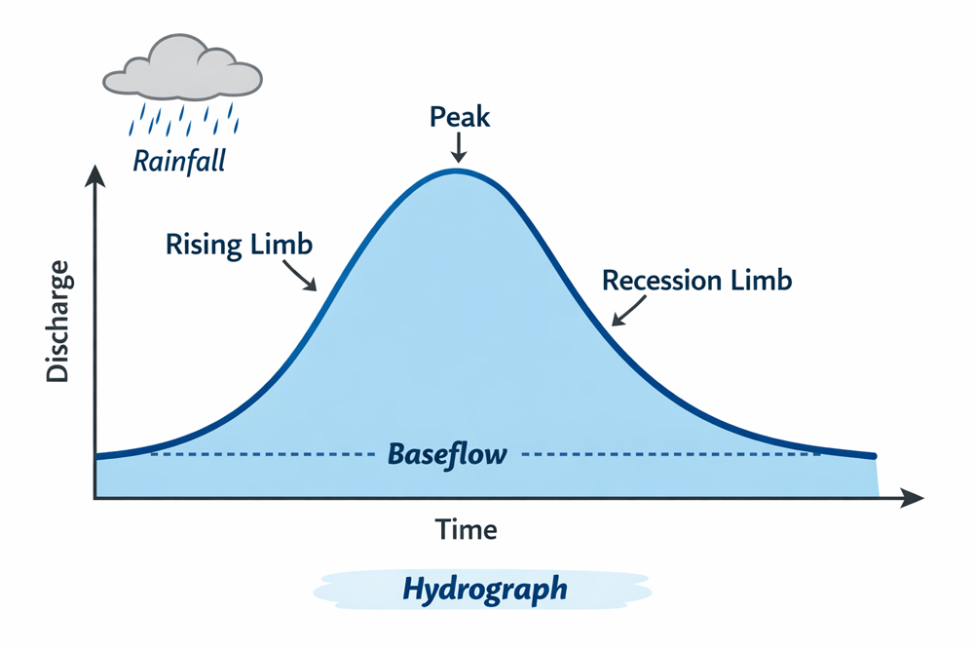
The recession limb is the portion of a hydrograph that represents the gradual decline in streamflow or discharge following the peak of a storm event. It begins immediately after peak flow is reached and continues until the flow returns to pre-storm or baseflow conditions.
In stormwater management and hydrology, the recession limb reflects the depletion of stored water within a watershed after rainfall or snowmelt has ceased or significantly diminished. During this phase, direct surface runoff rapidly decreases, and streamflow becomes increasingly dominated by delayed sources such as interflow and baseflow contributions from groundwater. As a result, the slope of the recession limb is typically more gradual than the rising limb of the hydrograph.
The shape and duration of the recession limb are influenced by several watershed characteristics, including soil permeability, storage capacity, vegetation, channel geometry, and underlying geology. Watersheds with high infiltration and substantial subsurface storage, such as forested or permeable areas, tend to exhibit a long, gently sloping recession limb, indicating sustained release of groundwater. In contrast, highly urbanized or impervious watersheds often have a short, steep recession limb, reflecting rapid drainage and limited storage.
Hydrologically, the recession limb is important because it provides insight into groundwater behavior, watershed storage, and drainage efficiency. It is often analyzed to estimate parameters such as groundwater recession constants and to separate baseflow from total streamflow in hydrograph analysis.
From a design and management perspective, understanding the recession limb helps engineers evaluate how long elevated flows will persist after a storm, which can influence channel stability, erosion potential, and the performance of stormwater infrastructure.
The recession limb is the falling segment of a hydrograph that illustrates the gradual reduction in flow after peak discharge, governed primarily by the release of stored water from the watershed.