

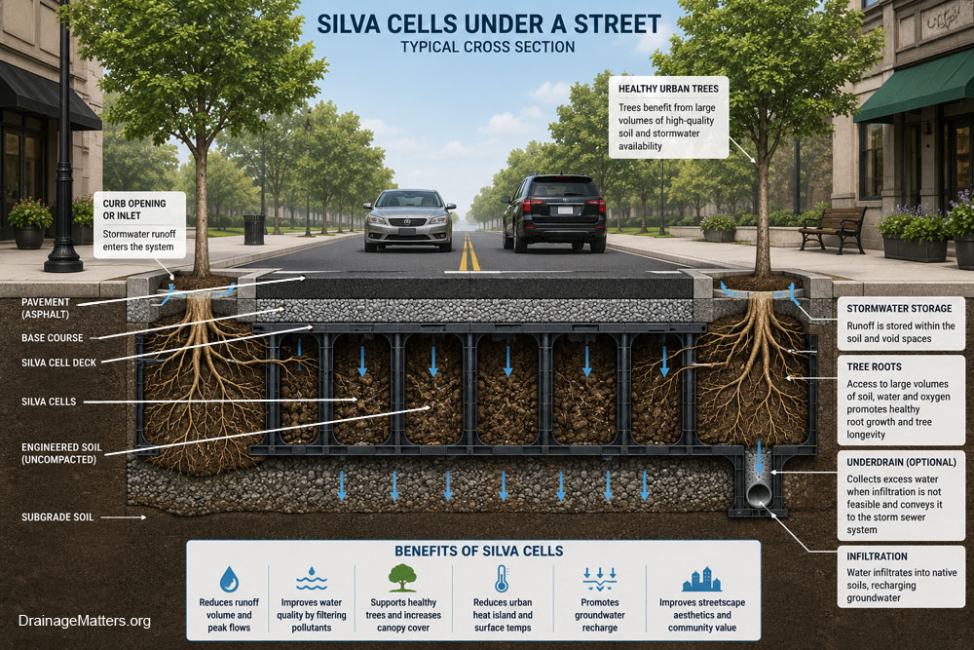
Silva Cells are modular underground structural support systems designed to provide large volumes of uncompacted soil beneath pavements while simultaneously supporting sidewalks, streets, plazas, parking lots, and other surface loads. In stormwater management, Silva Cells function as a form of green infrastructure by combining urban tree planting with stormwater capture, storage, filtration, and infiltration.
Developed by DeepRoot Green Infrastructure, Silva Cells consist of high-strength plastic frames stacked beneath paved surfaces and covered by decking that supports the pavement above. The open framework creates large underground spaces that are filled with high-quality soil, allowing tree roots to grow and expand without the compaction typically associated with urban environments.
Traditional urban tree installations often place trees in small, isolated pits surrounded by compacted soil and pavement, severely limiting root growth and access to water and nutrients. Silva Cells address these limitations by providing substantially larger rooting volumes beneath adjacent pavement, resulting in healthier trees, increased canopy growth, longer tree lifespans, and improved resilience to drought and environmental stress.
Stormwater runoff from streets, sidewalks, rooftops, and parking areas can be directed into Silva Cell systems through curb openings, trench drains, catch basins, or surface inlets. Once inside the system, runoff is temporarily stored within the soil and void spaces, where pollutants are removed through sedimentation, filtration, adsorption, biological uptake, and microbial processes.
Depending on site conditions and design objectives, water may infiltrate into underlying native soils, be absorbed by trees through evapotranspiration, or be collected by underdrains and conveyed to downstream drainage systems. The systems can therefore be designed as either infiltration practices or filtration practices.
Silva Cells provide numerous stormwater management benefits, including runoff volume reduction, peak flow attenuation, groundwater recharge, pollutant removal, and thermal mitigation. Because stormwater infiltrates through cooler soils rather than flowing directly across heated pavement surfaces, these systems can also help reduce thermal pollution in receiving waters.
Beyond stormwater treatment, Silva Cells contribute to urban forestry goals by improving tree health, increasing shade, reducing urban heat island effects, improving air quality, sequestering carbon, and enhancing streetscape aesthetics and pedestrian comfort.
Silva Cells are commonly installed beneath sidewalks, downtown streets, parking lots, public plazas, institutional campuses, and redevelopment projects where space constraints make traditional green infrastructure practices difficult to implement.
Although "Silva Cell" is a proprietary product name, the term is often used generically to describe suspended pavement systems or underground soil cell technologies that support urban trees while providing stormwater management functions. Similar systems may be offered by other manufacturers using different designs and configurations.
In stormwater management, Silva Cells represent an important example of multifunctional green infrastructure that integrates stormwater treatment, urban forestry, and transportation infrastructure into a single system capable of providing long-term environmental and community benefits.