

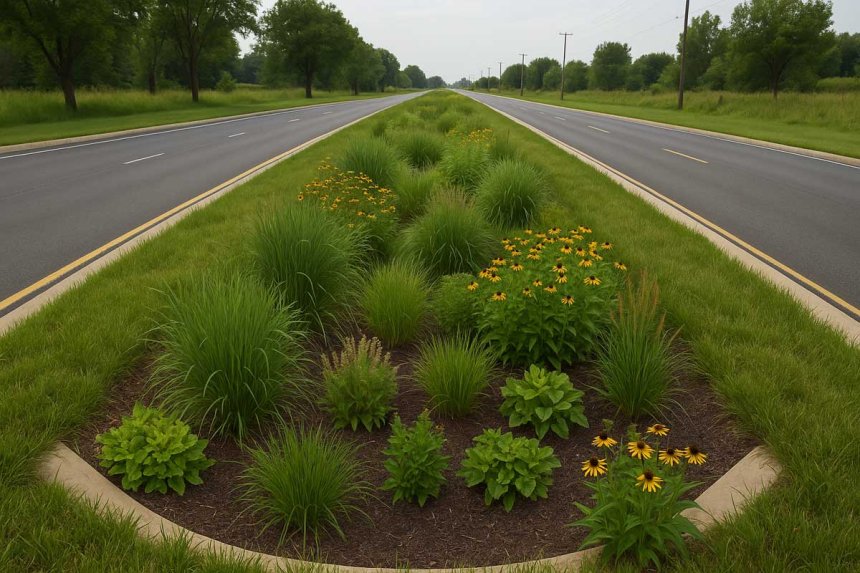
As communities look for sustainable ways to manage stormwater, bioswales have become one of the most effective and visually appealing tools in the green infrastructure toolbox. They blend natural processes with engineered design to slow, filter, and infiltrate stormwater before it reaches local waterways. For public works departments, planners, and MS4 coordinators, understanding how bioswales function is key to designing systems that truly protect watershed health.
A bioswale is a gently sloped, vegetated channel designed to capture and convey runoff while removing pollutants through infiltration and biological uptake. Unlike a traditional ditch that simply directs stormwater to the nearest outfall, a bioswale allows water to soak into the ground, filtering sediment and contaminants through layers of soil, sand, and vegetation.
Bioswales are commonly used along roads, parking lots, and other impervious surfaces. They serve as a buffer between built environments and natural waterways, intercepting runoff where it’s most concentrated.
The operation of a bioswale is both simple and sophisticated. As stormwater enters the swale, it slows down due to the shallow slope and dense vegetation. This reduced velocity allows sediments to settle out, while the water percolates through engineered soil layers that remove pollutants through physical, chemical, and biological processes.
Together, these processes mimic the natural hydrology that’s often lost when land is developed.
A properly functioning bioswale relies on several engineered elements working in harmony:
For municipalities managing stormwater under MS4 permits, bioswales offer several measurable benefits:
Bioswales are particularly effective when used in series with other stormwater practices, such as rain gardens, permeable pavement, and detention ponds.
Like all stormwater assets, bioswales require regular maintenance to perform as intended. Municipal crews should conduct routine inspections to check for sediment buildup, clogged inlets, dead vegetation, or standing water. Annual maintenance often includes mowing or trimming vegetation, replanting bare spots, and removing debris or invasive species.
Tracking these activities within an asset management system ensures maintenance records are defensible and accessible for MS4 reporting.
Bioswales exemplify the shift toward using natural systems to solve engineered challenges. They protect local water resources, support regulatory compliance, and add visual character to the urban landscape. As more municipalities move toward resilient, sustainable infrastructure, bioswales will continue to play a vital role in managing stormwater where it falls.
Bioswales are part of a broader family of green infrastructure practices designed to manage stormwater close to where it falls. While each system has a unique purpose, they share a common goal: reducing runoff and improving water quality through natural filtration and infiltration.
| Practice | Primary Function | Typical Location | Key Characteristics |
|---|---|---|---|
| Rain Garden | Captures and infiltrates runoff from roofs or small paved areas | Residential or small commercial lots | Shallow depression with ornamental vegetation |
| Bioswale | Conveys, filters, and infiltrates stormwater from larger surfaces | Along roadways, parking lots, or medians | Elongated, vegetated channel designed for flow |
| Bioretention Cell | Provides advanced treatment through layered soil media | Parking lots, urban plazas, landscaped areas | Engineered basin with underdrain, mulch, and high-performance media |
| Infiltration Trench | Rapid infiltration to recharge groundwater | Along road edges or beneath permeable pavement | Gravel-filled trench, often below grade and unplanted |
| Constructed Wetland | Stores and treats large volumes of stormwater | Downstream of drainage systems | Mimics natural wetlands with permanent pools and wetland vegetation |
In practice, bioswales often serve as the “front line” of stormwater treatment, capturing and slowing flow before it enters more intensive systems like bioretention cells or constructed wetlands. They balance hydraulic function with ecological and aesthetic value, making them an ideal fit for municipal corridors and roadway projects seeking both compliance and community appeal.